
The holiday season brings with it an undeniable craving for classic treats, and while social media feeds might be overflowing with an endless array of innovative Christmas cookies – from peppermint Hershey’s Kisses drops to intricate whoopie pies adorned with every conceivable mix-in – sometimes, the heart simply longs for tradition. This year, my festive spirit led me back to the comforting embrace of a good, old-fashioned sugar cookie, meticulously decorated with a gentle festivity and crowned with a perfectly sweet, creamy icing. There’s a certain magic in these simple delights that modern concoctions, however creative, can’t quite replicate.
These aren’t just any sugar cookies; they embody the very essence of holiday cheer. According to the timeless depictions of Norman Rockwell, these are precisely the kind of sweet indulgences one would leave out for Old Saint Nick himself, ensuring maximum gift efficiency and a truly memorable Christmas Eve. Imagine the aroma of vanilla and butter filling your home, transporting you to a simpler time, a time of warmth, family, and undeniable holiday spirit. This recipe promises not just a cookie, but a cherished tradition in the making.
Why This Christmas Sugar Cookie Recipe is Unforgettable
What sets this particular Christmas sugar cookie recipe apart from the countless others? It’s a harmonious blend of carefully balanced flavors and textures, designed for an exquisite melt-in-your-mouth experience. These cookies are wonderfully buttery and sweet, but never cloyingly so. The dough yields a soft, tender texture that practically dissolves on your tongue, providing the perfect canvas for a luxurious icing that sets beautifully, offering a satisfying contrast without being hard or brittle. You’ll find yourself reaching for a second, and then a third, unable to resist their delicate charm.
The accompanying icing is a true game-changer. It brilliantly mimics the elegant appearance of a classic royal icing, known for its pristine finish, yet it’s incredibly simple to whip together while your freshly baked cookies are cooling. This means less stress and more enjoyment during your busy holiday preparations. Forget complicated techniques and hard-to-find ingredients; this buttercream comes together in minutes, delivering a rich, creamy flavor that perfectly complements the buttery cookie base. It’s truly the only Christmas sugar cookie and frosting recipe you’ll ever need, destined to become a staple in your annual holiday baking repertoire.
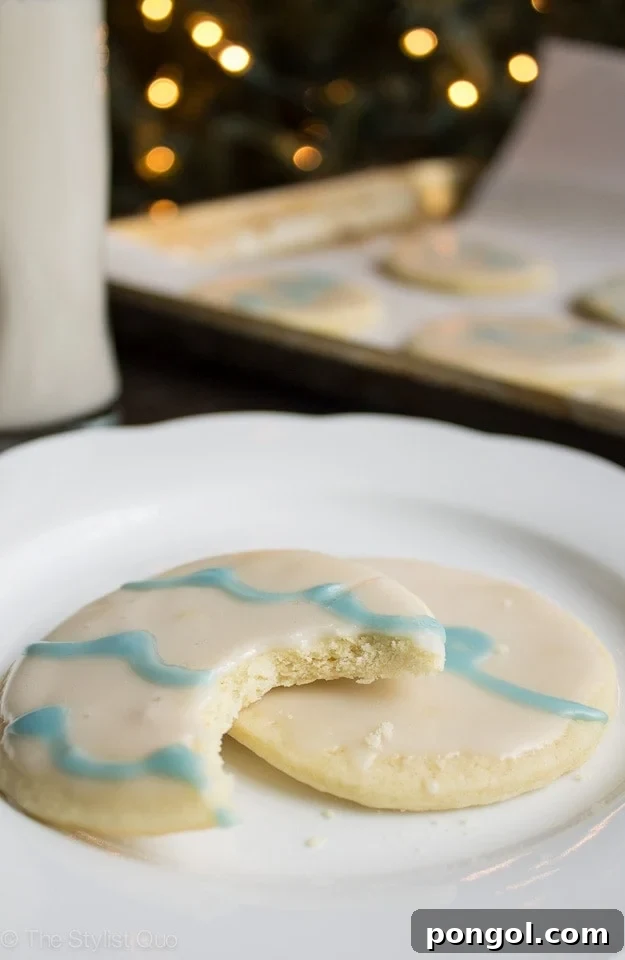
One of the most critical steps to achieving these perfectly shaped, tender cookies is to never, ever skimp on the chilling time for the dough. This isn’t just a suggestion; it’s a fundamental requirement for success. Keeping the butter and dough adequately cold is your ultimate defense against the cookies spreading excessively when they hit the heat of the oven. A properly chilled dough ensures your intricately cut shapes maintain their distinct edges and achieve that delightful, consistent texture we all crave in a classic sugar cookie. Patience truly is a virtue in this stage, and the results will speak for themselves in every beautifully formed, delectable bite.
Equally important is trusting in the seemingly low bake time. It’s a common temptation to let sugar cookies bake longer, especially when they don’t appear fully “done” at first glance. However, these cookies are designed for tenderness. Baking them for precisely 4 minutes will result in an incredibly soft, almost cake-like texture. Extending the bake to 5 minutes will yield a slightly firmer cookie, still wonderfully tender but with a bit more structure, making them ideal for handling and stacking. While I didn’t personally venture to 6 minutes, one can assume this would result in a much crunchier cookie. If a crispier sugar cookie is your preference, feel free to experiment, but for that signature soft, chewy center, adhere closely to the shorter bake times. The residual heat on the baking sheet will continue to set the cookies as they cool, so pulling them out when they look just slightly underdone is key to preventing dryness and achieving optimal tenderness.


Mastering the Art of Effortless Icing for Your Cookies
Once your beautiful sugar cookies have completely cooled, it’s time for the festive flourish – the icing! When it came to applying this delightful buttercream, I experimented with a couple of methods. Initially, I tried dipping the faces of the cookies directly into my small bowl of icing. While this technique can be quick and efficient for some cookies, I found that these soft, tender sugar cookies often created a slight suction with the icing, making them prone to pulling inwards or even breaking when I tried to gently lift them out. For my thicker-rolled cookies, where I wasn’t overly concerned with absolute uniformity in thickness, dipping worked surprisingly well. Their robust structure could handle the immersion without issue, resulting in a perfectly smooth, evenly coated surface.
However, for the more delicate, thinner cookies, especially those made from pieced-together scraps of dough, the painting method proved to be far superior and much safer. I discovered the easiest approach was to simply drop a small spoonful of icing right in the center of each cookie. From there, I used a clean pastry brush to carefully paint the frosting outwards, gently spreading it to the edges. This method offers significantly more control, allowing you to achieve a smooth, even layer of frosting without risking damage to the softer cookies. You can also use a small offset spatula or the back of a spoon for similar results, ensuring every cookie gets its perfect coat of holiday sweetness.
For adding a touch of color, like the whimsical blue I used, the process is wonderfully straightforward. I simply set aside a small portion of the plain white icing in a separate bowl and mixed in just one tiny drop of blue food coloring. A little goes a long way to achieve a soft, pastel hue! Once colored, I spooned the blue icing into a small Ziploc bag, carefully snipped off just the very corner to create a tiny opening, and voilà – I had a makeshift mini-piping bag. This allows for simple lines, dots, or borders, adding an extra layer of festive charm without needing professional piping skills. I have no patience for intricate, elaborate decorating, so if you’re a true cookie artist, feel free to unleash your creativity! But if, like me, your cookie decorating skills are still in development, don’t blame the cookies if your designs are more whimsical than perfect; blame me! Despite my self-professed lack of artistry, I found the final result possessed a charming, handmade touch that perfectly captured the spirit of the season.

Essential Tips for Sugar Cookie Success
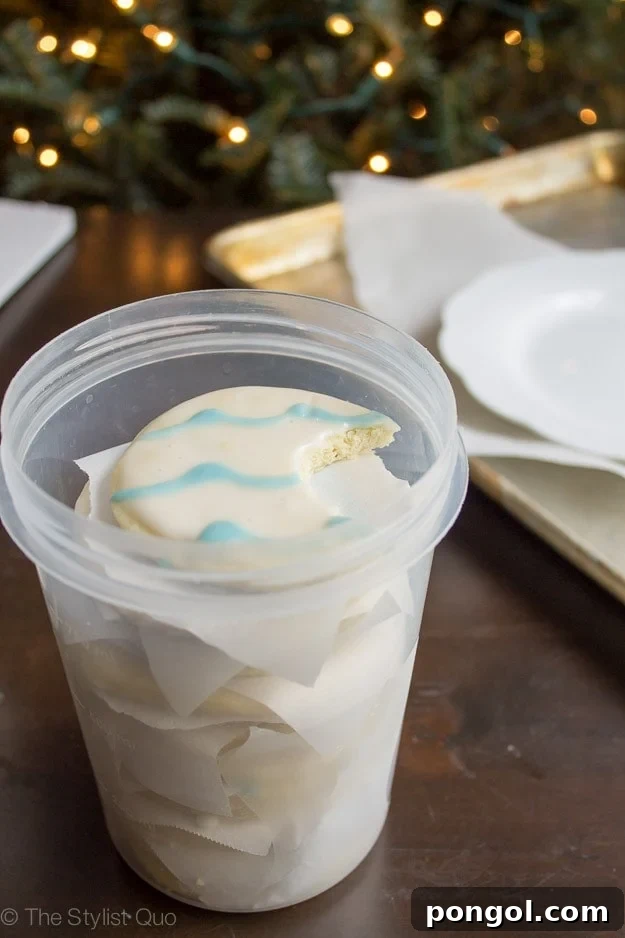
Baking delicious sugar cookies doesn’t require a professional kitchen, but a few key tips can elevate your results from good to absolutely fantastic. Firstly, don’t worry if your cookie cutter collection isn’t extensive. I personally used an approximately 3.25-inch circular cutter, which serendipitously produced cookies that fit beautifully when stacked within a standard 4-cup Ziploc reusable container. To keep the delicate icing pristine and prevent any sticking, I simply placed small scraps of parchment paper in between each stacked cookie. This simple trick ensures that your beautifully decorated treats remain picture-perfect until they’re ready to be devoured or gifted.
Beyond cookie cutters, here are some additional insights to guarantee your success:
- Quality Ingredients Matter: While simple, the quality of your butter and vanilla extract can significantly impact the final flavor. Opt for good quality ingredients for the best results.
- Accurate Measuring: Especially with flour, precise measurements are key. Use a spoon to lightly fill your measuring cup, then level it off with a straight edge rather than scooping directly from the bag, which can compact the flour and lead to dry cookies.
- Rolling Between Parchment: For easy handling and to prevent sticking, roll your dough between two sheets of parchment paper. This minimizes the need for extra flour on your surface, which can toughen the cookies, and makes transferring cut shapes to baking sheets a breeze.
- Even Thickness: Aim for a consistent dough thickness (1/4 to 1/8 inch) for even baking. Thinner cookies will be crisper, while thicker ones will remain softer and chewier.
- Cool Completely: Before even thinking about frosting, ensure your cookies are entirely cool. Warm cookies will melt your beautiful buttercream, creating a messy situation.
- Storage Solutions: Unfrosted sugar cookies can be stored in an airtight container at room temperature for up to 5 days, or frozen for up to 3 months. Once frosted, store them in a single layer (or with parchment in between) at room temperature for 3-4 days. The dough itself can also be prepared ahead and refrigerated for up to 3 days, or frozen for up to 3 months, making holiday baking much less stressful.
- Make-Ahead Mastery: Consider making the dough a day or two in advance. The chilling time allows the flavors to meld beautifully, and having the dough ready means you can bake and decorate in stages, spreading out the holiday cheer (and the workload!).
These classic Christmas sugar cookies are more than just a recipe; they are an invitation to create cherished memories. They’re undeniably delicious, visually charming, and surprisingly simple to master. Go ahead, make these this holiday season! You’ll be glad you did, and so will everyone lucky enough to enjoy them.

Classic Christmas Sugar Cookies
Cheryl Malik
Equipment
-
Stand mixer with paddle attachment or electric hand mixer
-
Mixing bowls
-
Rolling pin
-
Cookie cutters for various shapes
-
Two baking sheets
-
Parchment paper or silicone baking mats
-
Offset spatula or butter knife for frosting
Ingredients
For the Christmas Cookies
- 1 cup unsalted butter softened
- 1 ½ cups granulated sugar
- 2 large eggs
- 1 ½ teaspoons pure vanilla extract
- 3 ½ cups all-purpose flour
- 1 teaspoon baking powder
- ½ teaspoon fine sea salt
For the Buttercream Frosting
- ½ cup unsalted butter softened
- 16 ounce package powdered sugar (about 4 cups)
- 3 tablespoons half-and-half (or whole milk)
- 1 teaspoon pure vanilla extract
- Gel food coloring optional, for festive colors
- Colored granulated sugar for topping optional, sprinkles, or edible glitter
Instructions
Prepare the Cookies
-
In the bowl of a stand mixer fitted with the paddle attachment (or using an electric hand mixer), cream together the 1 cup of softened butter with 1 1/2 cups of granulated sugar. Gradually add the sugar, beating on medium speed until the mixture is light, fluffy, and pale in color, typically for 2-3 minutes.
-
Add the 2 large eggs one at a time, beating well after each addition until fully incorporated. Stir in the 1 1/2 teaspoons of pure vanilla extract until just combined. Scrape down the sides of the bowl as needed.
-
In a separate medium bowl, whisk together the 3 1/2 cups of all-purpose flour, 1 teaspoon of baking powder, and 1/2 teaspoon of fine sea salt. Gradually add this dry flour mixture to the creamed butter mixture, mixing on low speed until just combined and a soft dough forms. Be careful not to overmix.
-
Divide the dough into two equal portions. Flatten each portion into a disk, wrap tightly in plastic wrap, and refrigerate for a minimum of 8 hours, or preferably overnight. The dough can be refrigerated for up to 3 days. This chilling step is crucial for flavor development and to prevent the cookies from spreading during baking.
-
When ready to bake, preheat your oven to 400°F (205°C). Line two baking sheets with parchment paper or silicone baking mats. Work with one-fourth of the chilled dough at a time, keeping the remainder in the refrigerator. On a lightly floured surface (or between two sheets of parchment paper), roll the dough to an even thickness of 1/4-inch to 1/8-inch.
-
Cut out desired shapes using assorted cookie cutters. Carefully transfer the cut cookies to the prepared baking sheets, leaving about 1 inch between each cookie. Re-roll any dough scraps until all dough is used.
-
Bake at 400°F (205°C) for 8 to 9 minutes, or until the edges are just barely golden. The centers may still look slightly soft, but they will set as they cool. Do not overbake for tender cookies. Cool the cookies slightly on the baking sheets for about 5 minutes, then transfer them to wire racks to cool completely before frosting.
Make the Buttercream Frosting
-
While the cookies are cooling, prepare the frosting. In a clean mixing bowl, cream together the 1/2 cup of softened butter with the entire 16-ounce package of powdered sugar until light and fluffy.
-
Add 3 tablespoons of half-and-half (or whole milk) and 1 teaspoon of pure vanilla extract. Beat on medium-high speed until the frosting is smooth, creamy, and reaches a perfect spreading consistency. If too thick, add more half-and-half one teaspoon at a time; if too thin, add a little more powdered sugar.
-
Divide the frosting into separate bowls if you wish to color it. Add a tiny drop of gel food coloring to each bowl and mix until the desired shade is achieved. Spread the frosting onto the completely cooled cookies using an offset spatula, butter knife, or pastry brush.
-
Immediately sprinkle with colored granulated sugar, sprinkles, or edible glitter if desired, before the frosting sets. Allow frosted cookies to sit for at least 30 minutes to an hour to allow the frosting to set before stacking or packaging.
Chilling is Essential: The 8-hour (or longer) chill time for the dough is absolutely non-negotiable for achieving cookies that maintain their shape and have the perfect tender texture. The butter needs to solidify to prevent spreading, and the flavors benefit from the resting period. The dough can be made ahead and refrigerated for up to 3 days, making it ideal for busy holiday schedules.
Rolling Tips: Always work with a small portion of dough at a time, keeping the rest of the dough chilled in the refrigerator to prevent it from becoming too warm and sticky. If your dough starts to get too soft while you’re rolling and cutting, simply return it to the refrigerator for 15-20 minutes to firm up again. Use a generous amount of flour on your work surface and rolling pin to prevent sticking, or roll the dough between two sheets of parchment paper for a mess-free experience.
Avoid Overbaking: For truly tender sugar cookies, pull them from the oven when they are just barely golden around the edges, typically around 8 to 9 minutes. They might appear slightly underdone in the very center, but they will continue to firm up and cook as they cool on the hot baking sheet. Overbaked cookies will lose their softness and become dry and crumbly.
Frosting Patience: Ensure your cookies are completely, thoroughly cooled before applying any frosting. If the cookies are even slightly warm, your beautiful buttercream will melt and slide right off. After frosting, allow the decorated cookies to sit for at least 30 minutes (or longer) to allow the frosting to set before stacking them or packaging them for gifts.
Storage Best Practices: Unfrosted cookies can be stored in an airtight container at room temperature for up to 5 days, or frozen for up to 3 months. Once frosted, store them in a single layer (or with parchment paper between layers) in an airtight container at room temperature for 3 to 4 days for optimal freshness.
Freezing Dough & Baked Cookies: For ultimate convenience, you can wrap the cookie dough tightly in plastic wrap and freeze it for up to 3 months. Thaw it overnight in the refrigerator before rolling and baking. Alternatively, you can cut out unbaked cookies and freeze them flat on a baking sheet until solid, then transfer to a freezer bag. Bake from frozen, adding 1 to 2 minutes to the baking time.
Approximate Nutrition Information
Approximate Information for One Serving
Nutrition Disclaimers
Number of total servings shown is approximate. Actual number of servings will depend on your preferred portion sizes.
Nutritional values shown are general guidelines and reflect information for 1 serving using the ingredients listed, not including any optional ingredients. Actual macros may vary slightly depending on specific brands and types of ingredients used.
To determine the weight of one serving, prepare the recipe as instructed. Weigh the finished recipe, then divide the weight of the finished recipe (not including the weight of the container the food is in) by the desired number of servings. Result will be the weight of one serving.
Did You Make This Recipe?
Tag @40aprons on Instagram and be sure to leave a review on the blog post!
Tag @40Aprons on Instagram