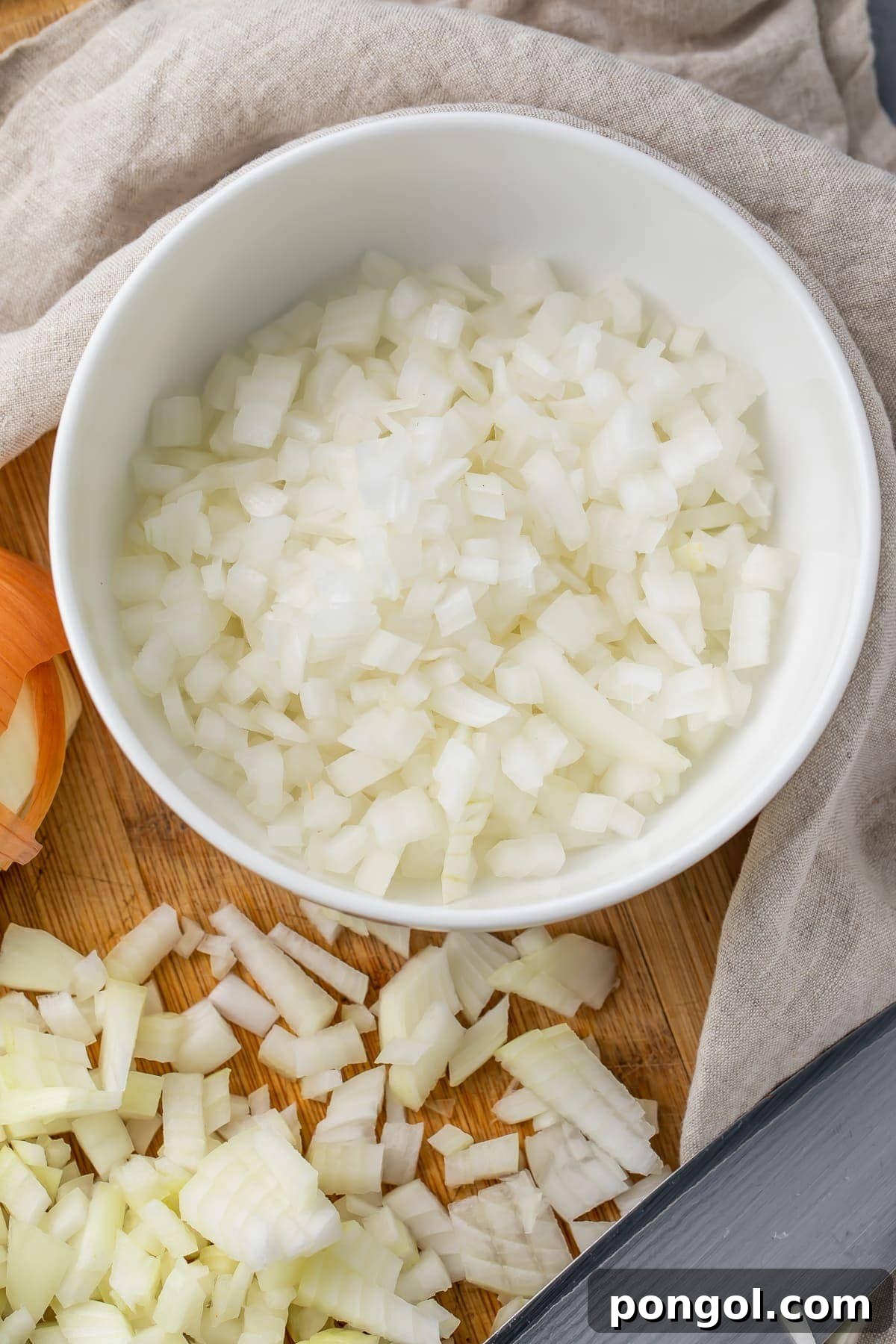
Do you want to master the art of dicing an onion effortlessly? This revolutionary method for dicing onions is not only quicker and simpler than traditional approaches but will also transform you into a kitchen pro, ready to tackle any recipe that calls for perfectly diced onion. Say goodbye to uneven pieces and hello to culinary precision!
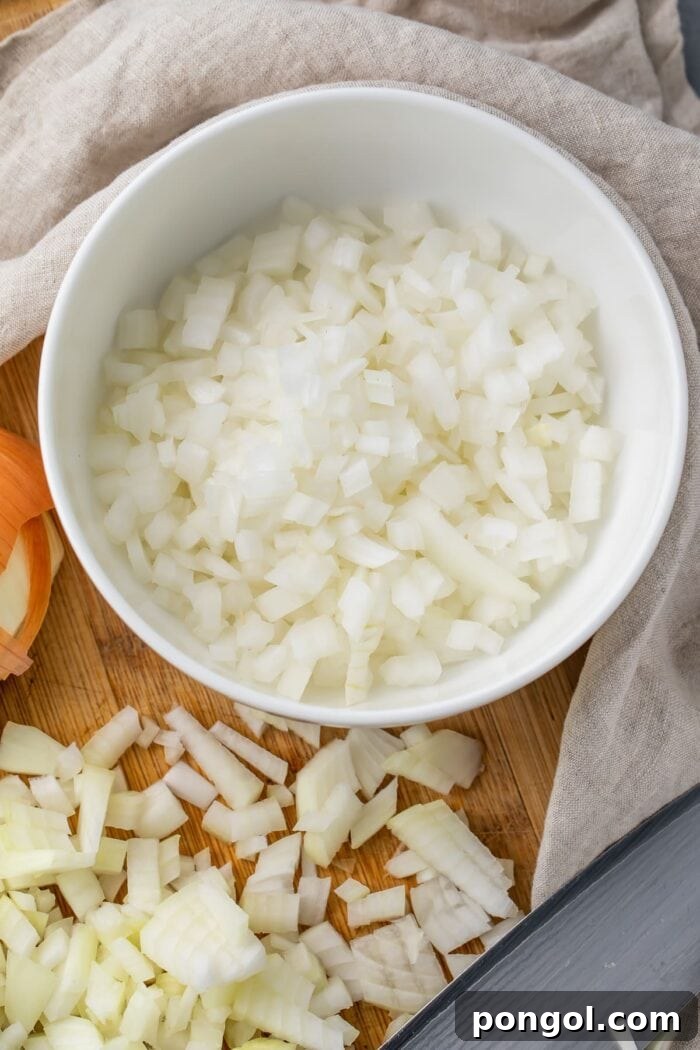
Whether you’re a seasoned chef or just starting your culinary journey, knowing how to properly dice an onion is a fundamental skill. Many home cooks find onion preparation intimidating, but it doesn’t have to be. This detailed guide is designed to walk you through a superior dicing technique, ensuring you can prepare onions easily, quickly, and, most importantly, safely. No more struggling with inconsistent cuts or worrying about knife accidents – just beautifully diced onions ready for your next culinary creation.
We’ve meticulously crafted this post to provide you with everything you need, from a comprehensive overview of the method to invaluable chef’s tips that will elevate your dicing game significantly. While a how-to video and a concise recipe card are available further down for quick reference, we highly recommend reading through the expert advice section first to gain insights that will truly enhance your understanding and execution of proper onion dicing.
Why Mastering This Essential Kitchen Technique is a Game Changer
Understanding how to efficiently and accurately dice an onion is more than just a convenience; it’s a foundational skill that unlocks a world of culinary possibilities. It’s an undeniable truth that precise and consistent onion cuts can significantly impact the outcome of your dishes, both in taste, texture, and visual presentation.
- Unmatched Efficiency and Precision for Flawless Cooking: Forget about haphazard chopping that makes your dishes look amateurish. This foolproof method guarantees uniform, fine chunks of onion every time. This consistency is crucial for even cooking, ensuring that all pieces soften or caramelize at the same rate, and for optimal flavor distribution throughout your dish. It streamlines your prep work, allowing you to focus on the joy of cooking rather than the chore of cutting, making you feel like a true kitchen professional.
- A Universal Staple for Diverse Diets and Global Cuisines: Onions are a truly universal ingredient, celebrated across countless cultures and culinary traditions worldwide. Their natural composition makes them compliant with a wide array of dietary preferences, including Paleo, Whole30, low-carb, Keto, gluten-free, dairy-free, refined sugar-free, vegetarian, and vegan. This incredible adaptability means you can effortlessly incorporate them into almost any meal, making them an indispensable pantry item regardless of specific dietary restrictions. Remember to always be mindful of the ingredients you pair them with to maintain your diet’s integrity.
- Incredibly Versatile Flavor Enhancer in Every Form: Diced onions are truly a culinary chameleon! Their remarkable ability to complement an extraordinary range of different flavors makes them indispensable in a chef’s repertoire. You can enjoy their crisp, pungent bite raw in vibrant salads, add a sharp counterpoint to savory hot dogs, or transform their character entirely through cooking. Sauté them to tender perfection, caramelize them slowly to unlock deep, sweet, and complex notes, bake them into comforting casseroles or savory egg cups, or even toss them in the Instant Pot with other ingredients for quick and flavorful meals. Given their omnipresence in countless recipes, mastering this fundamental skill will undoubtedly simplify your cooking process and significantly broaden your culinary horizons.
- Ideal for Efficient Meal Prepping and Time Savings: Planning your meals just got significantly easier! Diced onions can be prepared in advance, saving you valuable time during busy cooking sessions throughout the week. When stored properly in an airtight container, they will remain wonderfully fresh and crisp in the refrigerator for 7-10 days. An airtight seal is absolutely crucial, not only to preserve their peak freshness and texture but also to effectively prevent their distinct, pungent aroma from permeating other foods stored in your fridge. This makes them a perfect and highly practical ingredient for weekly meal prep, allowing you to quickly assemble meals when time is short.
- Universally Adaptable to Various Onion Types: Whether your recipe calls for the sharp zest of a yellow onion, the mild sweetness of a white onion, the vibrant color and gentle bite of a red onion, or the delicate flavor profile of a sweet onion like Vidalia, this dicing method is universally applicable. Understanding how to expertly handle any onion type ensures you’re perfectly prepared for whatever your recipe demands, consistently achieving the desired texture and size without needing to learn a new technique for each variety.
Essential Tools for Perfect Onion Dicing
Having the right tools is paramount for both efficiency and safety when preparing onions. Investing in quality equipment and understanding how to use it correctly will make a significant difference in your kitchen experience, transforming a potentially tedious task into a quick and enjoyable one.
- A Very Sharp, Large Kitchen Knife: This is arguably the most critical tool for dicing onions. A sharp chef’s knife, typically ranging from 8 to 10 inches in blade length, is highly recommended. Smaller knives can technically be used, but they often make the process more cumbersome, less efficient, and can require more effort, thereby increasing the risk of accidental slips. A truly sharp knife glides effortlessly through the onion with minimal pressure, cleanly severing cells rather than crushing them. This not only results in cleaner cuts and fewer tears but also drastically reduces the chances of the blade slipping and causing injury. Even if you believe your knife is sharp, a quick honing or sharpening session right before tackling your onions will immensely improve your experience, making the task safer and more precise.
- A Sturdy and Sufficiently Sized Cutting Board: When you’re dicing one or multiple onions, ensure your cutting board provides ample space for comfortable and safe maneuvering. A large board prevents ingredients from spilling over, keeping your workspace tidy and reducing potential distractions. For added safety, especially if your board tends to slide around on your countertop, place a damp paper towel or a non-slip kitchen towel underneath it. This simple yet effective trick provides a stable, anchored surface, allowing you to focus entirely on your knife work without worrying about the board shifting. High-quality materials like wood, bamboo, or high-density plastic boards are all excellent choices for durability and knife-friendliness.
- The Onion Itself: As previously mentioned, this versatile method works for any type, any size, and any number of onions you choose to prepare. For the best dicing experience, always select fresh, firm onions that feel heavy for their size. These are not only easier and safer to cut but also offer superior flavor and texture in your dishes.
Chop, Dice, or Mince? Understanding the Nuances of Onion Cuts
When it comes to culinary terms, precision truly matters. The old saying “size doesn’t matter” certainly doesn’t apply to how you cut an onion in the kitchen! The primary distinction between what chefs refer to as chopped, diced, and minced onion lies solely in the final, intended size of the individual pieces.
These terms are frequently used interchangeably in recipes and casual conversation, particularly “chop” and “dice,” but they technically represent distinct cut sizes with different culinary applications. Generally, chopped onion refers to the largest, often less uniform pieces, followed by diced onion, which are small, even cubes, with tiny minced onion being the absolute smallest and most finely divided. Recipes might further specify “roughly chopped” (implying larger, irregular pieces) or “finely diced” (calling for very small, uniform cubes), indicating the exactness and consistency required for your cuts. For a “rough chop,” uniformity isn’t a critical factor, allowing for varied sizes that are perfect for slow-cooked dishes where they will break down. It’s also worth noting that a “small chop” in a recipe is often equivalent to “diced,” indicating a preference for smaller, more consistent pieces.
So, why is this guide focused primarily on how to dice an onion? Because the fundamental knife technique and hand positions remain precisely the same regardless of the desired final cut size! The only variable that changes the resulting size of your onion pieces is the width of the initial slices you make in the early stages of the dicing process. For standard “diced” onion, aim for approximately ½-inch wide slices. If you need “minced” onion, you would reduce your initial slice width to a finer ¼-inch. Conversely, for “chopped” onion, you would increase your initial slice width to a larger ¾-inch to 1-inch. This inherent adaptability makes mastering just one core dicing method incredibly powerful and efficient for all your various onion preparation needs.
Chef’s Advanced Tips for Tear-Free and Safe Dicing
Beyond the basic dicing technique, these expert tips from seasoned chefs will help you manage common challenges encountered when preparing onions, making the entire process far more enjoyable, efficient, and, most importantly, safer in your kitchen.
Conquering Onion Tears: Practical Solutions
The infamous onion tears are a common and often frustrating complaint among home cooks. The scientific culprit behind this phenomenon is syn-propanethial-S-oxide, a volatile sulfur compound that is rapidly released into the air when onion cells are cut or crushed. Luckily, several proven strategies can significantly help minimize its irritating effects on your eyes:
- Chill Your Onions to Slow Down Reactions: One of the most consistently effective methods is to significantly reduce the onion’s temperature. Place the whole onion in the freezer for 15-20 minutes before you begin cutting, or simply store it in the refrigerator until you’re ready to use it. Colder temperatures effectively slow down the enzymatic reaction that produces the tear-inducing compounds, thereby keeping your eyes much drier and more comfortable.
- Ensure Good Ventilation for Dispersion: Always try to cut your onions in a well-ventilated area. This could mean working near an open window, directly under a powerful range hood, or even with a small fan blowing gently across your cutting board (ensuring the airflow is directed away from your face). Good air circulation helps to quickly disperse the volatile irritants before they have a chance to reach and affect your eyes.
- Cut Near Running Water: Some experienced chefs and home cooks find that cutting onions near a running tap or a shallow bowl of water can be quite helpful. The theory is that the water vapor absorbs some of the sulfur compounds, preventing them from becoming airborne and irritating your eyes.
- Use a Razor-Sharp Knife: This cannot be overstated. A truly sharp knife makes clean, precise cuts, which damages fewer onion cells compared to a dull blade. When fewer cells are ruptured, fewer irritating compounds are released into the air. A dull knife tends to crush cells, leading to a much greater release of the tear-inducing chemical.
- Protective Eyewear for Sensitive Eyes: For individuals who are particularly sensitive to onion fumes, consider wearing specialized onion goggles (available online) or even a pair of tightly sealed swimming goggles. While perhaps not the most fashionable kitchen accessory, they are remarkably effective at creating a barrier that blocks the compounds from reaching your eyes.
Prioritizing Kitchen Safety: Essential Knife Handling Techniques
While mastering how to dice an onion easily is a fantastic skill, doing it safely is absolutely paramount. Your fingers are invaluable, so always exercise the utmost caution and awareness when working with a sharp blade:
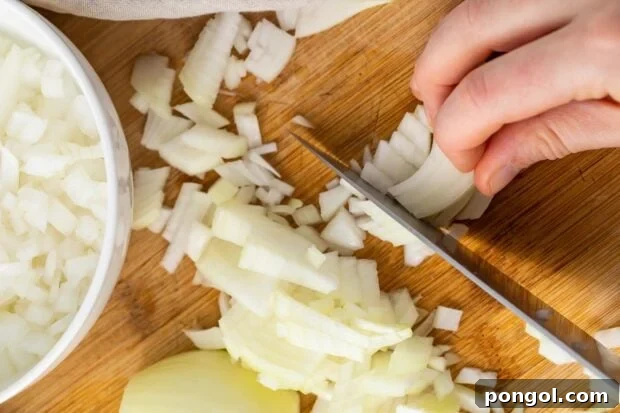
- The Crucial “Claw” Method for Finger Protection: This fundamental knife grip technique is vital for preventing accidents. When holding the onion with your non-dominant hand, curve your fingers into a “claw” shape, tucking your fingertips firmly underneath your knuckles. The flat side of your knuckles should then act as a natural guide for the knife blade as you make your cuts. This technique keeps your delicate fingertips safely tucked away from the blade’s path, dramatically reducing the risk of accidental cuts.
- Maintain Unwavering Focus: Always dedicate your full attention to your knife work. Kitchen accidents often occur due to distractions. Before you even begin, ensure your cutting board is stable, your knife is sharp, and your mind is clear and focused on the task at hand.
- Adopt a Proper Knife Grip: Hold your chef’s knife with a firm yet relaxed grip. The most effective grip involves pinching the base of the blade between your thumb and the side of your index finger, with your remaining fingers comfortably wrapped around the handle. This grip provides optimal control and leverage over the blade.
- Post-Dicing Hygiene and Face Contact: After you’ve successfully finished dicing your onion, it is imperative to avoid touching your face – especially your eyes! The chemical compounds that cause tears will inevitably be on your hands. Getting these compounds directly into your eyes will be far more irritating and painful than what you experience from airborne particles. Always wash your hands thoroughly with warm soap and water immediately after handling onions. Furthermore, if you happen to have any cuts, abrasions, or open wounds on your fingers or hands, wearing food-safe gloves while handling and dicing onions is highly recommended for both protection against irritation and general food hygiene.
Step-by-Step Guide: How to Dice an Onion Like a Professional
Follow these simple, clear, and detailed steps to achieve perfectly diced onions every single time. Remember, practice makes perfect, so don’t be discouraged if your first few attempts aren’t absolutely flawless. Consistency will come with experience.
Recipe Overview
Recipe By: Cheryl Malik
Prep Time: 15 minutes
Cook Time: 0 minutes
Total Time: 15 minutes
Summary: This guide provides the easiest, fastest, and safest method to dice an onion like a true culinary professional. Achieve consistent, even pieces that enhance any recipe’s flavor and presentation.
Servings: Yields approximately 1 cup of diced onion per medium onion, typically serving 8 small portions as an ingredient.
Equipment You’ll Need
- A sturdy and sufficiently sized cutting board
- A very sharp kitchen knife (a chef’s knife, ideally 8-10 inches, is highly recommended)
Ingredients
- 1 onion (any type, any size – this method is universally applicable)
Instructions for Dicing an Onion
-
Step 1: Prepare the Onion by Trimming the Ends
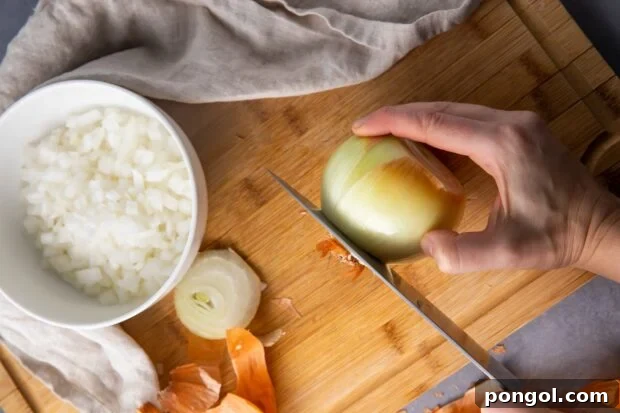
Begin by peeling away the dry, papery outer layers of the onion. These are typically tough and not edible. Then, using your very sharp kitchen knife, carefully cut off both the top (stem end) and the bottom (root end) of the onion. Ensure these cuts create flat, stable surfaces on both ends. The root end, though trimmed, will be used to hold the onion’s layers together in later steps, so don’t cut off too much.

Carefully trim both ends of the onion to create stable, flat surfaces for easier cutting. -
Step 2: Halve the Onion Vertically
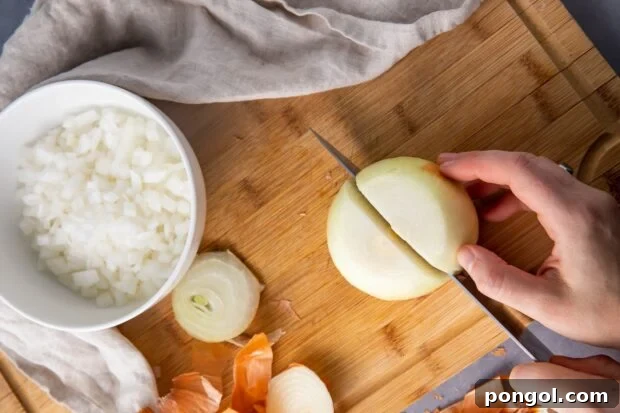
Place the onion upright on your cutting board, resting it securely on one of its newly flattened ends. With your knife, slice the onion cleanly and precisely into two equal halves, cutting vertically down from the trimmed top to the trimmed bottom. This central cut will expose the onion’s natural layers and make all subsequent steps significantly easier.
Halve the onion lengthwise through its center for uniform sections. -
Step 3: Remove Any Remaining Outer Layers
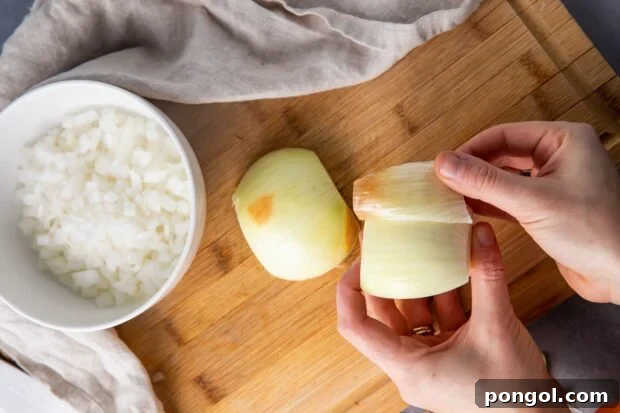
With the onion now halved, you might find some thicker, discolored, or slightly damaged outer layers remaining on the exposed surfaces. Carefully peel these away until you reach fresh, clean, and firm onion layers. You should now have two neat, ready-to-dice onion halves, each with a flat side and a curved side.
Peel off any remaining papery, discolored, or loose outer layers. -
Step 4: Execute Vertical Slices (The First Set of Cuts)
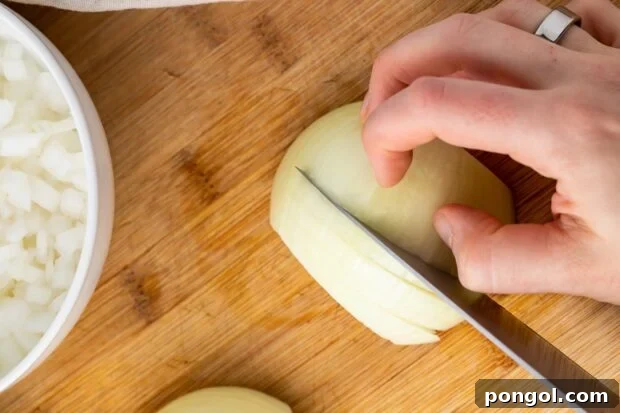
Lay one peeled onion half flat-side down firmly on your cutting board, positioning one of its curved edges facing directly towards you. Using the crucial “claw” grip (fingertips tucked), make even vertical slices along the onion. For standard “diced” onion, aim for slices approximately ½-inch apart. Remember, you can adjust this width for minced (¼-inch) or chopped (¾-inch to 1-inch) results. Critically, these slices should only extend to about ¾- to 1-inch from the root end, leaving the base intact. This attached root end acts as a natural binder, holding the onion’s layers together and making the subsequent cuts much safer and easier.
Make parallel vertical slices across the onion, leaving the root end attached. -
Step 5: Perform Horizontal Angled Cuts (The “Fan” Method)
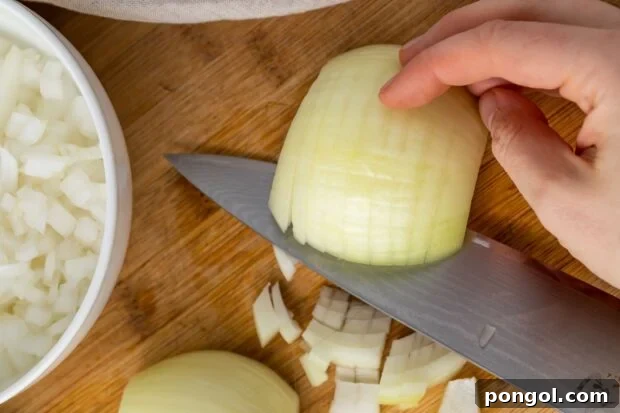
Now, rotate the onion so that one of its flat ends (where you initially cut off the top) is facing towards you, and the still-attached root end is opposite your cutting hand. Following the natural, concentric curve of the onion, make precise horizontal angled cuts. These cuts should also be roughly ½-inch apart (or your desired cut size) and extend completely through to the center of the onion. Work your way around the onion half in a fanning motion, always keeping your guiding hand in the protective “claw” position for optimal safety and control. This creates the initial, interconnected dice structure.
Execute horizontal angled cuts following the onion’s natural curve to form the initial dice shape. -
Step 6: Address the Remaining Attached Side
Once you’ve expertly made all the fanned horizontal cuts, you will be left with the small, still-attached root end portion of the onion. For this final section, make ½-inch wide slices in the remaining piece of onion, positioning your knife parallel to the outermost edge of the onion. This ensures that the last section of the onion is also fully prepared and cut into uniform strips, ready to be diced.
Slice the remaining attached portion into uniform strips, parallel to the onion’s edge. -
Step 7: The Final Dice – Completing the Cubes
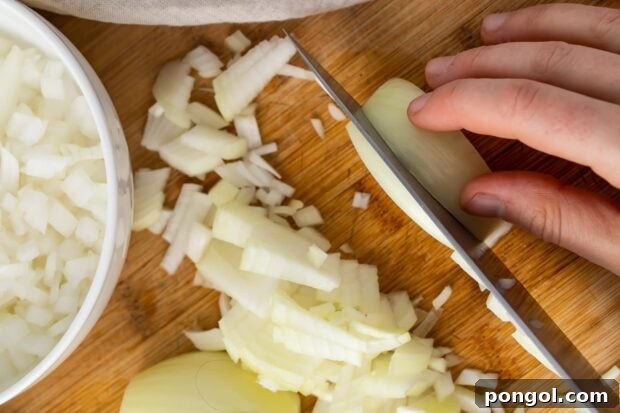
With all your initial cuts made, now rotate your onion slices onto their sides, so the long strips are facing you. Make even, downward cuts every ½-inch across these prepared slices to complete the dicing process. As you cut, the interconnected pieces will effortlessly fall away into perfect, uniform cubes. Continue this action until the entire onion half is beautifully diced and ready.
Complete the dicing by cutting across the prepared slices, forming perfect cubes. -
Step 8: Repeat and Store Your Diced Onions
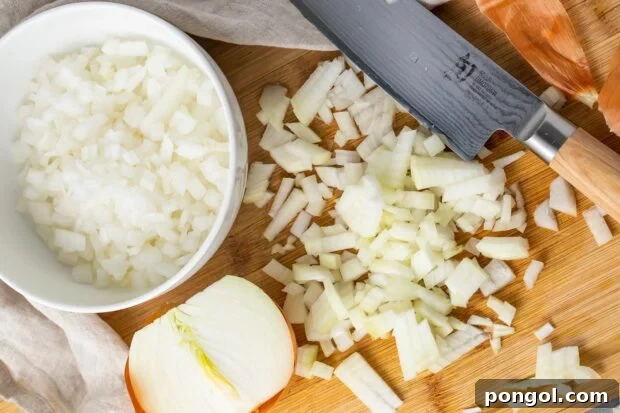
Repeat this entire dicing process meticulously with the other half of the onion until it is completely and evenly diced. You may find a few pieces with multiple layers still attached; simply break them apart gently with your fingers to ensure full separation. Your perfectly diced onions are now ready for immediate use in your favorite recipes, or they can be refrigerated in a sealed, airtight container for up to 10 days to maintain freshness and prevent odor transfer.
Enjoy your uniformly diced onions, ready to enhance any culinary creation!
Chef’s Notes and Customization Tips
- Onion Versatility: This dicing method is incredibly versatile and works flawlessly for any size, any type, and any quantity of onions you need to prepare. From tiny shallots to large Spanish onions, the technique remains consistent.
- Cut Size Customization: While this guide primarily focuses on achieving a perfect “dice,” the same core technique applies universally to chopping and mincing. The key difference and point of customization lies solely in the width of your initial slices in Step 4. For standard “diced” onion (small, even cubes), use ½-inch wide slices. For “minced” onion (very tiny pieces), reduce to ¼-inch wide slices. For “chopped” onion (larger, less uniform pieces), increase to ¾-inch to 1-inch wide slices.
- Storage Best Practices: To maintain the freshness, crispness, and prevent any unwanted odor transfer to other foods, refrigerate any leftover diced onion in a sealed, airtight container. When stored correctly, they will remain vibrant and usable for up to 10 days, making them perfect for meal prep.
Approximate Nutrition Information for One Serving
Please note that the number of total servings shown is approximate, and actual serving sizes may vary based on individual portion preferences. Nutritional values provided are general guidelines and reflect information for 1 serving, using the ingredients listed and excluding any optional components. Actual macronutrient values (macros) can differ slightly depending on specific brands, varieties, and types of ingredients used.
For precise nutritional tracking, to determine the exact weight of one serving, prepare the recipe as instructed. Once the recipe is finished, weigh the entire completed dish (ensuring to exclude the weight of the container the food is in) and then divide this total weight by your desired number of servings. The result will be the accurate weight of one individual serving.
- Serving Size:
- 1 serving (out of 8 total)
- Calories:
- 6 cal
- Protein:
- 1 g
- Fat:
- 1 g
- Saturated Fat:
- 1 g
- Sodium:
- 1 mg
- Potassium:
- 20 mg
- Total Carbs:
- 1 g
- Fiber:
- 1 g
- Sugar:
- 1 g
- Net Carbs:
- 0 g
- Vitamin A:
- 1 IU
- Vitamin C:
- 1 mg
- Calcium:
- 3 mg
- Iron:
- 1 mg
Unlock the Flavor: Creative Ways to Use Your Perfectly Diced Onions
Now that you’re an absolute expert in dicing, it’s time to put those perfectly uniform pieces to fantastic use in your kitchen! Diced onions are far more than just a humble background ingredient; they’re a versatile flavor builder and texture enhancer that can elevate almost any dish from ordinary to extraordinary. Their consistent size ensures even cooking and distribution, providing a delightful textural and aromatic foundation whether they are cooked down or enjoyed fresh and raw.
From adding a crisp, pungent bite to fresh, vibrant salads to providing a sweet, aromatic base for hearty stews, perfectly diced onions integrate seamlessly into a vast array of recipes. Here are some of our favorite and most creative ways to incorporate this freshly prepared ingredient:
- Fresh & Vibrant Dishes:
- Chickpea Salad (Mediterranean Style): Adds a delightful crunch and sharp, fresh flavor that brightens the entire dish.
- Avocado Salad: Balances the rich creaminess of the avocado with a refreshing zest and crisp texture.
- White Bean Salad: Provides essential texture and a savory, aromatic edge that complements the beans.
- Mexican Salad with Cilantro-Lime Dressing: Essential for that fresh, zesty profile and authentic crunch in every bite.
- Topping for Hot Dogs or Burgers: A classic, indispensable topping for an added layer of piquant zing.
- Sautéed & Caramelized Staples:
- Sautéed Onions: The fundamental starting point for countless dishes, becoming tender, translucent, and sweetly aromatic.
- Fried Rice: Provides a foundational aromatic layer that infuses the rice with depth and flavor.
- As a Flavor Base: An essential first ingredient for building rich, umami-packed flavors in any sauce, soup, or stew.
- Hearty Soups & Stews:
- Whole30 Chili: A must for adding significant depth, body, and savory complexity to your chili.
- Bison Chili & Nourishing Slow Cooker Chili: Enhances the robust, earthy flavors of any hearty chili.
- 15-Minute Hearty Chickpea Soup & Vegan Chili: Adds essential aromatics and a satisfying textural element.
- Shrimp Etouffee & Shrimp Gumbo: Absolutely integral to the flavor base of classic Cajun and Creole cuisine.
- Baked & Casserole Fillings:
- Turkey Stuffed Peppers: Blends seamlessly into savory, moist fillings, adding flavor and preventing dryness.
- Breakfast Casseroles & Egg Cups: Adds savory flavor, moisture, and delightful pockets of texture.
- Easy 7 Layer Salad: A crucial, flavorful layer for both texture and taste within this classic dish.
- Instant Pot & One-Pot Wonders:
- Instant Pot Jambalaya: Essential for building complex, authentic flavors quickly and efficiently.
- Ranch Style Beans & Instant Pot Baked Beans: Creates a savory, aromatic base that deeply flavors the beans.
- Unique & Global Flavors:
- Whole30 Enchiladas with Poblano-Pork Stuffing & Creamy-Avocado Sauce: Infuses the savory filling with rich, aromatic flavor.
- Healthy Lettuce Wraps – PF Changs Recipe (Whole30, Paleo): Adds a crisp, fresh, and aromatic element to the vibrant filling.
- Whole30 Fish Taco Bowls with Mango Salsa: Contributes to the vibrant, balanced flavor profile of the fresh mango salsa.
- Whole30 Strawberry Basil Chicken with Avocado: A surprising yet delicious aromatic addition that enhances the dish’s complexity.
- Shredded Chicken Tacos & Air Fryer Hot Dogs: Elevates these simple meals with an essential aromatic and textural component.
This comprehensive list is by no means exhaustive, but merely a glimpse into the incredible and expansive versatility of perfectly diced onions across a myriad of culinary applications. Once you truly master this simple yet profound kitchen skill, you’ll find yourself instinctively reaching for perfectly diced onions to enhance, deepen, and elevate almost everything you cook!
Expand Your Kitchen Mastery: Other Essential How-To Guides
Building on your newfound onion dicing expertise, why not take the opportunity to explore other fundamental kitchen techniques that will further enhance your cooking prowess? These curated guides offer valuable insights into various culinary preparations and food handling, ensuring you’re well-equipped and confident for any kitchen challenge that comes your way.
- How to Truss a Chicken
- How to Freeze Corn (on the Cob and Kernels)
- Orange Zest – How to Make It and Ways to Use It
- How to Freeze Peaches
- How To Cut a Pineapple Easily
- All About Lemon Zest + 4 Ways to Zest a Lemon
- How to Cook Turkey Bacon in the Oven
- How to Freeze Broccoli (with 3 Cooking Methods)
Final Thoughts: Your Journey to Confident Onion Prep Starts Here
Congratulations! After absorbing the invaluable techniques, practical tips, and detailed instructions shared in this comprehensive guide, you are now undoubtedly well on your way to becoming an onion dicing expert. No longer will the mention of “diced onion” in a recipe prompt a moment of panic or hesitation; instead, you’ll approach it with newfound confidence, precision, and skill. This foundational knowledge will empower you to tackle prep work efficiently, saving time and significantly enhancing the overall quality, consistency, and enjoyment of your home cooking. Embrace your expanded culinary abilities and continue to explore the endless, delicious adventures that await you in the kitchen!
Did You Master This Recipe? We’d Love to Hear From You!
We absolutely love to see your culinary creations and hear about your kitchen successes! If you’ve used this guide to expertly dice an onion for your latest dish, please share your photos and tag @40aprons on Instagram. Don’t forget to leave a comment or review on this blog post to let us know how this detailed guide helped you master the art of dicing onions!